Blog Post 2
Because of the drugs and the problems with people harming themselves, my parents asked the council to move us. One of the places we were offered was Grenfell Tower near Ladbroke Grove. Many people will know about the tragedy that happened there, so luckily we didn’t end up living there. Instead, we moved to a council estate in Hammersmith, which had its own troubles but was a big improvement from where we were and what we were originally offered.
I remember my dad telling me a story about one place we visited to live and he said the front door was broken in half and you could smell the flat from the street outside, another lucky escape.
I started school, and instantly I knew it was a place where I felt uncomfortable. It wasn’t just because of what I later found out was dyslexia, but also because of excessive worrying and intrusive thoughts, which eventually led to me discovering I had OCD. But, just like my dyslexia, that diagnosis came later. I’ll go into the OCD perhaps later in another post. I’ve always felt different and with a feeling of walking against traffic, not wanting to do what everyone else seemed happy to do, living a hole world in my head, drifting in to thoughts that totally leave me from the world around me. I never thought of myself as a day dreamer but my children have made me aware of it, that I go off somewhere, in to my mind where I’m joined by this anxious monkey banging his symbols relentlessly.
When it came to my dyslexia, it’s fair to say I was treated very badly in school and not just by the students, which in some ways is more understandable looking back, as kids don’t know any better, but more unforgivably also and more often by the teachers. I experienced isolation and humiliation throughout my school life. I wasn’t allowed to take part in certain lessons. I’d be asked to “sit over there and just draw or something” instead of taking part, or on the other hand, made to stand up and read aloud to which of course I couldn’t do and it was well known I couldn’t by everyone, but for some reason they took joy out of deliberately humiliating me. The school was aware that I may have had dyslexia but chose to ignore it, as it would’ve been costly and they would’ve had to make provisions for me, not to mention none of the teachers I had seem to want to be there or to have any interest in education. Even after leaving school, I was still unable at that stage to write my name fully, or do simple things like the alphabet, reading, or even naming the months of the year. The only exam I managed to pass was Art. School was absolutely awful, full of bullying and very troubled people, students and teachers alike.
After leaving school, I began looking into the possibility that I was dyslexic, with the support of my parents. Eventually, I found someone who completely transformed my life, Patricia Stringer, an adult dyslexia educational psychologist. She was able to teach me, in a matter of hours, more than I had learned throughout my entire schooling. I remember in the first session she praised me so much for not giving up, for persevering. Outside of my parents and family, I don’t think I had ever received any praise or compliment before. I was truly taken back, and even nearly 30 years later I can picture it like it was yesterday. It was the first time anyone had said anything genuinely positive to me, again as I said other than my family.
One of the great things about being dyslexic for me is that I’ve develop an incredibly thick skin when it comes to failure. You grow up used to being the person who “never gets it right.” And in the art world, you have to have this resilience, it has made me a person who never gives up. Another thing I’ve found is that my dyslexia has made me very empathetic towards anyone who struggles, anyone who doesn’t immediately understand something or finds learning difficult in any way. I worked with Patricia Stringer for over two years, developing the skills I missed out on at school and building my confidence. I had a goal to prove everybody wrong who had doubted me, and that goal was to go to university. This was obviously a huge goal for someone who was still unable to write their own name and I saw this as the stamp of showing everyone I weren’t an idiot. (not true going to university dose not mean your not an idiot, I have ment of very well educated idiots throughout my life) I did eventually go to university, though I didn’t end up studying art. I’ll go into that maybe in a later post.
Based on what I know now, I guess we would’ve been considered poor. We lived in a poor area and we didn’t have much money, but I never felt poor as a kid. I was so well looked after by my mum and dad and so loved. Being poor to me were the kids at school who were not washed, who came in smelling of piss because they had probably spent the night in a wet bed, and just that very specific smell of someone who isn’t being looked after. That was poor in my mind: being emotionally and physically neglected. Kids who would sidle up to my mum just to get a hug,
We were looked after, our hair was brushed, we were clean and washed and had clean clothes on. My mum still tells stories about how we didn’t have any money, but I have no recollection of that. I just remember being loved more than anything. My mum and dad put us first over everything.
Now days It makes me laugh when I think about my own kids now. They have three or four pairs of waterproof trousers and jackets: a pair for when it snows, a pair for when it’s hot and raining, a pair for when it’s cold and raining. Snow shoes, hats, gloves, the lot, hundreds of things I can’t keep up with it. I distinctly remember being about six or so, and my dad picking me up from school when it was raining, and he would just put me in a bin bag to keep me dry. We never had an special clothes for weather, of course, that would’ve been on a day when he didn’t pick me up in the JCB.
My dad worked as a tarmacker, mending the roads, so he had a JCB that he used to drive. He’d let me drive it as a kid down the road on the way to and from school, sitting on his knee. My kids would love to do that now. I took it as normal, just chucking my school bag in the front of the digger and off we went through the middle of London. My dad would park on the council estate, and the other kids would sometimes break into the JCB just to flick the lights on or something. But they only ever did it once, my dad was not someone to be messing around with.
Why talk about this? Why am I bothering writing this down? That’s what’s been going through my head. I suppose one things that goes through my head is that the art world can be very snobby. I have many times felt like an impostor and someone on the outside, someone who doesn’t know enough or is just pretending, and that anytime now someone will work it out, work out that I shouldn’t be here and I’m just a fraud. I suppose writing this may share that you can come from anywhere or anything and still follow an unconventional dream or goal. I’m not saying I did anything great, coming from the situations I’ve come from and the place that I’ve grown up in, or that I have achieved anything within my chosen field to shout about, but I think people have this idea that you must’ve been given a lot of opportunities or you that you have come from a very fortunate background, and that’s simply not the case.
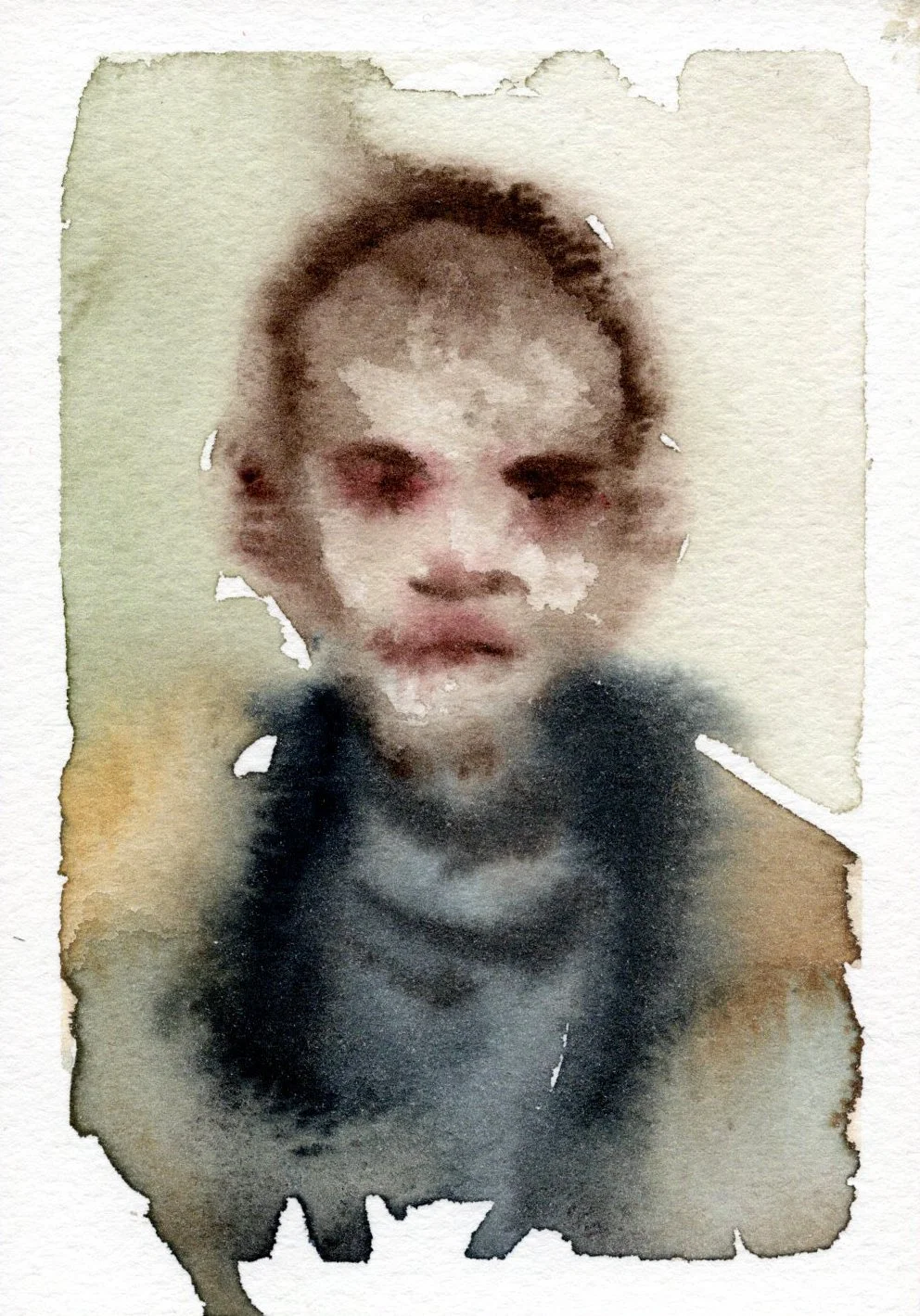
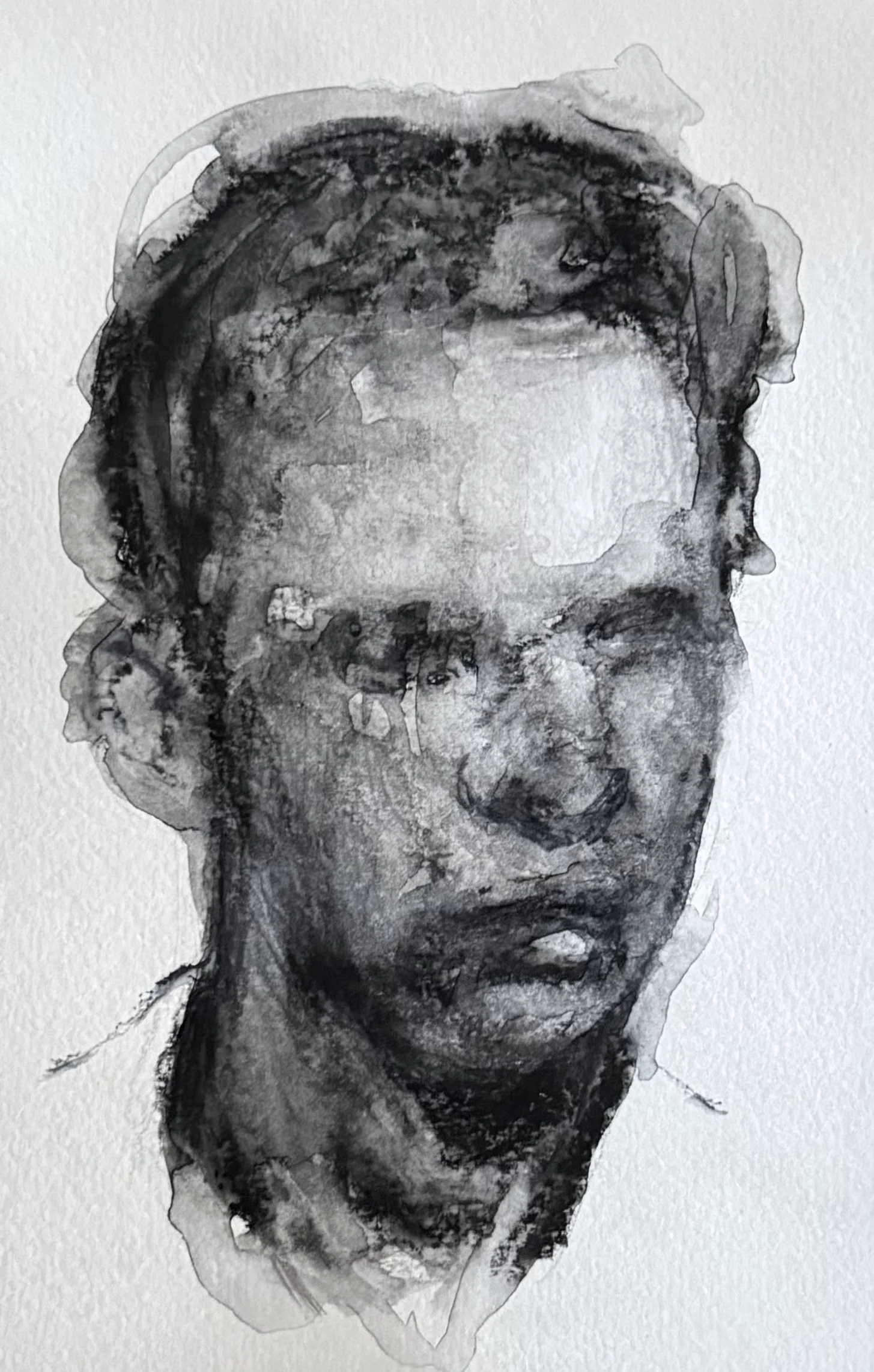
I’m fully aware that these parts of my life have affected the way that I work, in particular the dyslexia has given me a life long insecurity. I constantly have this sense of being trapped in a mindset of wanting to prove that I’m not an idiot. The effect of this in my own work means that there is a tendency that the end product, the piece of work that I make, has a level of technical proof in it, a flex of my artistic muscle, on a level to say that I am good at this. I am a figurative artist and the aim is for it to look like something, but the battle is between making something that looks good with a technical ability and the side that just wants to be free and wants to work purely on emotional response to what I’m doing, leading me into the more abstract possibly at least on a level where the process is the important part and not just a result. Being a self taught artist is plays into as well. I’m constantly thinking that not doing this right and everyone can see it. Im just made this up, the way that I’m doing is technically not right, and it probably isn’t, but again we come full circle on this feeling of being observed found out not getting it right being the fool. And the truth is I’m not very technical when it comes to my art, I don’t know the ins and out of the paper I use or the pigments I might be using and so on, and I have to say it’s a side that doesn’t really interest me, I know very little of art history and all the artists that have come before me I can never remember anybody’s name. I do know the stuff that moves me when I see it, but I still have found a way of working that makes me want to get up every day and keep trying, giving me such a purpose in life outside of family life which always comes first.
Artist to look at is: Olle Skagerfors. one of my favorite.
Song: Joan Baez. Forever Young. Love this version.
Poem: Not Waving but Drowning by Stevie Smith.
Book: Frankenstein. By Mary Shelley.
Film: Barnacle Bill.